
Prophylaxis of migraine with oral magnesium: results from a prospective, multi-center, placebo-controlled and double-blind randomized study
Attacks dropped 41.6% on magnesium, against 15.8% on placebo. Days with migraine also went down.
It's a fair question, and we asked it too. Migraine is not just a bad headache. It affects 1 in 7 people in the world, and it is associated with specific nutritional deficiencies. Dozens of clinical trials have tested whether vitamins, minerals and herbs can reduce how often migraines come and how intense they are. This page links to the ones we used to make Mighty, so you can read them yourself.
Research links migraine to a metabolic disorder in the brain. That difference makes people with migraine more likely to run low on key nutrients, and those deficiencies make migraines worse.
Brain scan and biochemical studies have found lower energy production together with higher energy use in people with migraine.
People with migraine are more likely to be low in magnesium, riboflavin, CoQ10 and vitamin D, which the brain uses to make energy.
That is why researchers have run trials that give these nutrients back and count what happens to people's migraine days.
Sources: Gross et al., Nature Reviews Neurology, 2019 and Cevoli et al., Current Medicinal Chemistry, 2019.
In 2012 the American Academy of Neurology and the American Headache Society reviewed the published trials of complementary treatments for migraine and rated each one. Read the guideline on PubMed.
Three of the trials we get asked about most, each against a placebo. Every study below links to its PubMed page.
People who cut their headache days at least in half
55 people, 400 mg a day for 3 months. Neurology, 1998. Read the studyPeople who cut their migraine attacks at least in half
42 people, 300 mg a day for 3 months. Neurology, 2005. Read the studyHow much the number of attacks dropped
81 people, 600 mg a day for 12 weeks. Cephalalgia, 1996. Read the studyAttacks dropped 41.6% on magnesium, against 15.8% on placebo. Days with migraine also went down.
Ten trials of magnesium taken by mouth, pooled. It reduced how often migraines came and how intense they were.
In people who have migraine without aura, magnesium reduced how often attacks came and how severe they were.
Magnesium on its own, and magnesium with L-carnitine, each reduced how often attacks came and how severe they were.
Magnesium given through an IV during an attack reduced migraine symptoms.
Magnesium given through an IV during an attack improved pain and other symptoms.
In children, magnesium oxide did not do better than placebo.
59% cut their headache days at least in half, against 15% on placebo. Attacks also came less often.
Nine studies pooled. 400 mg of vitamin B2 a day for three months reduced migraine days, duration, frequency and pain scores.
The first pilot study of high-dose riboflavin. Migraine symptoms improved.
Riboflavin reduced how often attacks came.
Vitamin B2 reduced migraine attacks in a trial that compared it with a prescription preventive.
A low 25 mg dose of riboflavin did about as well as the combination of riboflavin 400 mg, magnesium 300 mg and feverfew 100 mg.
In children and teenagers, riboflavin reduced how often migraines came.
In children, riboflavin had no significant effect on migraine symptoms.
In children, a 50 mg dose made no significant difference to how often migraine attacks came.
47.6% cut their attacks at least in half, against 14.4% on placebo. Headache days and days with nausea also went down.
Six trials pooled. CoQ10 reduced how often attacks came and how long they lasted. It did not change how severe they were.
CoQ10, feverfew and magnesium in one tablet. 75% of people cut their migraine days at least in half by the third month. This study had no placebo group.
CoQ10 reduced how often migraine attacks came.
Added to people's usual preventive treatment, CoQ10 reduced how often attacks came and how severe they were.
In children and teenagers with low CoQ10 levels, supplementing raised their levels and headaches came less often.
People started at about 4.8 attacks a month. Attacks fell by 1.9 a month on the feverfew extract and by 1.3 on placebo.
No overall difference from placebo. In people with at least four attacks a month, attacks fell by 1.8 a month on the middle dose, against 0.3 on placebo.
Ginger extract added to standard treatment during an attack. People on ginger responded better at 1, 1.5 and 2 hours than people on placebo.
Three trials pooled. More people on ginger were pain free at 2 hours, and pain scores were lower.
Zinc. Attack frequency fell by 2.55 on zinc and by 0.42 on placebo. The duration of attacks did not change.
Vitamin D3. Monthly headache days went from 6.1 to 3.3 on vitamin D, and from 5.7 to 4.9 on placebo. Severity did not change.
Folic acid, B6 and B12. The share of people disabled by migraine went from 60% to 30% after six months, with no reduction on placebo.
Describes migraine as a gap between the brain's energy reserve and its workload, and covers the brain scan, biochemical and genetic evidence that energy metabolism works differently in people with migraine.
Several biochemical and brain scan studies have found lower energy production together with higher energy use in the brains of people with migraine.
After reviewing the published trials, the panel rated riboflavin, magnesium and feverfew as probably effective and CoQ10 as possibly effective.
We have many more studies than fit on one page. These are the ones we share most often. If you'd like the source for something specific, or the longer list, email hello@joinmelina.com and we'll send it.
The studies above tested single ingredients or small combinations, and some used a different dose or form than Mighty does. A few found no benefit, and we list those too.
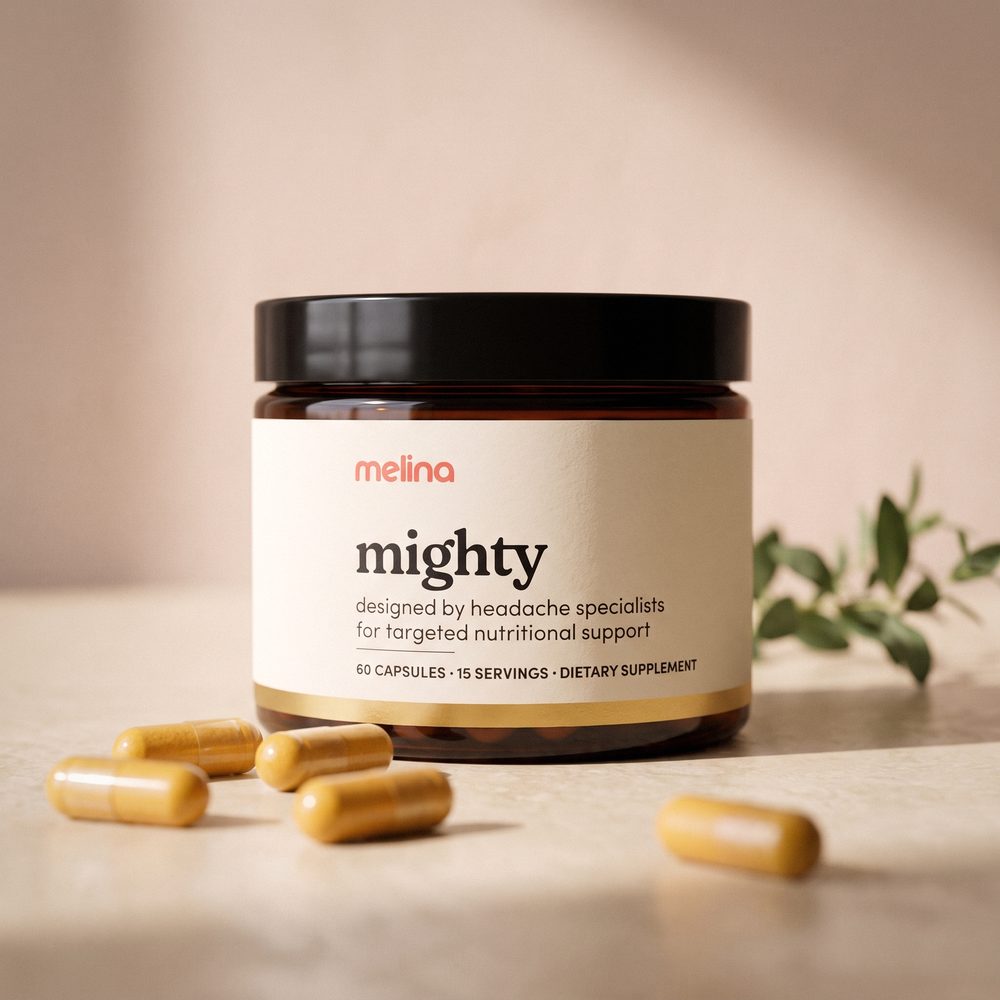
We built Mighty from this research and refined the formula with headache specialists. Every dose is on the label, so you can compare it with the studies and take it to your doctor.
Supplements are lightly regulated, so it is up to each company to do the right thing. This is what we do.
Mighty is made in a cGMP-certified facility in Washington state.
Each one is quarantined when it arrives and tested for microbes, heavy metals and potency.
Once blended, each batch goes to an independent lab that re-tests the finished product for the same three things.
This stuff is GREAT!!! I have been suffering from migraines for years. I have had spent money on doctors, prescriptions, hospital bills, and etc. I came across this back in December and after taking it for a week I noticed an immediate change. At first I was skeptical but this stuff has changed my life I wish could give them a big hug!!! Thank Y’all So Much!!!
I was skeptical about the impact of this supplement but after taking them for a month, I felt better and was far less dizzy. After an additional month of taking these supplements I was rarely dizzy, which was my initial reason for taking them.
I was skeptical that a supplement could make a big difference for my hormonal migraines. But I gave this a shot and was amazed that my severe menstrual migraines were reduced to mild tension headaches after a few weeks. This formula works differently than anything I've tried, because it's so comprehensive and targets multiple causes. No harsh side effects either. I recommend giving it at least 2 months to work. So grateful I found something natural that helps!
You have 90 days to ask for a refund if you're not satisfied. You can email us at hello@joinmelina.com, and we'll make things right for you.
Shop MightyThese statements have not been evaluated by the Food and Drug Administration. This product is not intended to diagnose, treat, cure, or prevent any disease.